How to Prepare Logo Artwork for Custom Cork Coasters
To prepare artwork for custom cork coasters, send a vector logo, simplify fine details for the natural grain, pick engraving or full-color print first, and keep the design inside a safe margin. Custom Cork Coasters checks every file, returns a free mockup within 24 hours, and makes unlimited free revisions before you approve anything.
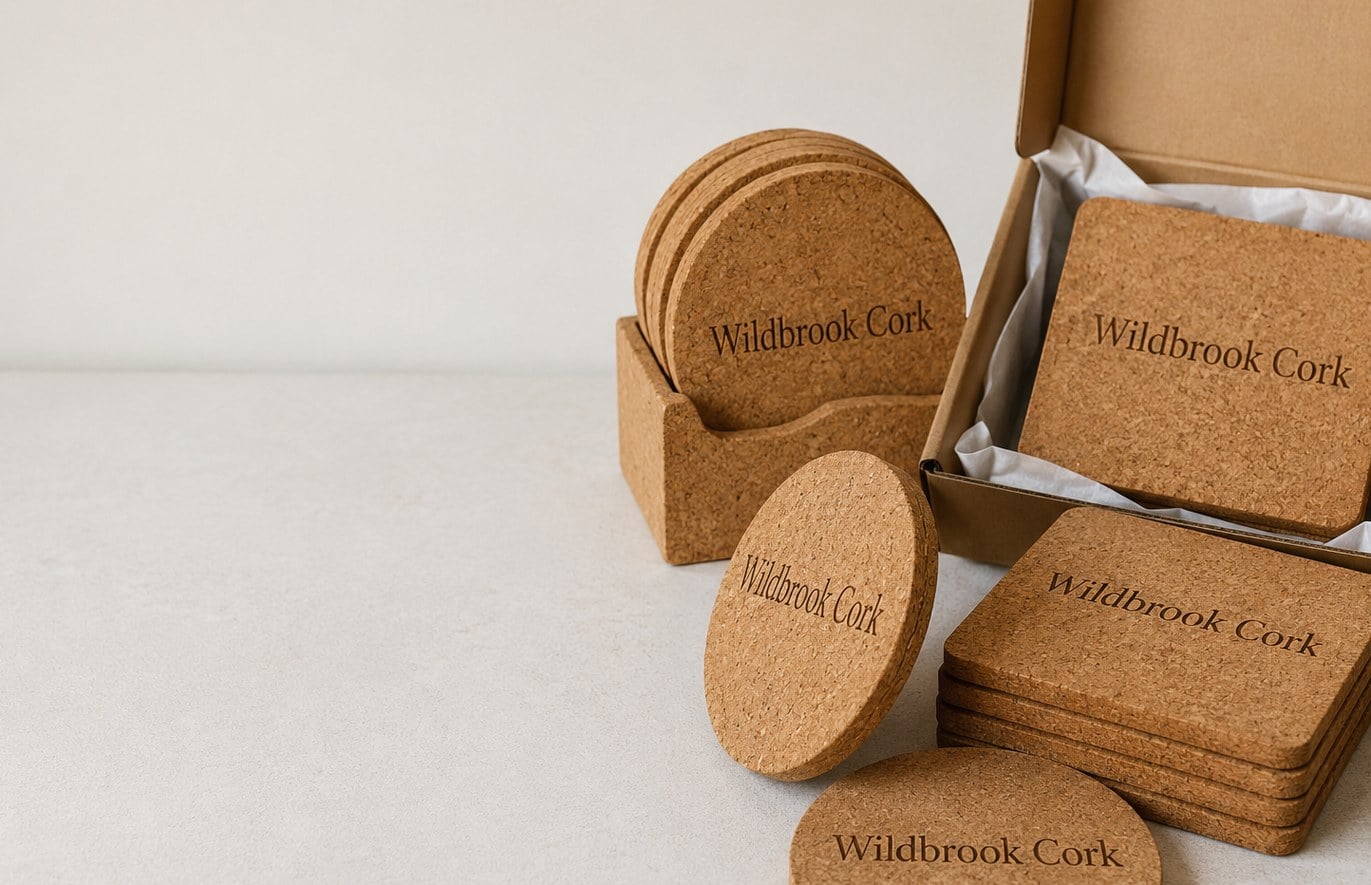
- Vector logo files (AI, EPS, SVG or PDF) give the cleanest engraving and print
- Engraving turns your logo into one natural burned tone; full-color print keeps brand colors
- Free mockup within 24 hours, with unlimited free revisions
- Minimum order of 12; standard turnaround about 2 weeks after approval
What logo file should I send for custom cork coasters?
For custom cork coasters, the best logo file is a vector: an AI, EPS, SVG or vector PDF where the shapes and text are built from paths rather than pixels. Vector art scales cleanly to any coaster size, gives the laser a crisp outline to follow, and lets the print team separate colors without guessing. If a vector file exists anywhere in your company, ask for it before you send anything else.
When only a raster file is available, send the largest, sharpest PNG or JPG you have, ideally the original from your designer rather than a copy saved from a website or an email signature. Small web logos look fine on a screen but break up into soft, jagged edges once they are enlarged across a coaster face. A screenshot of a logo is the weakest possible starting point.
Do not worry if you are unsure what you have. Send whatever files you can find through the quote form, and Custom Cork Coasters will tell you in the free mockup whether the art is ready, needs cleanup, or should be redrawn. That check costs you nothing, and you pay nothing until you approve the design.
- Best: vector AI, EPS, SVG or PDF with fonts converted to outlines.
- Workable: a large, high-resolution PNG with a transparent background.
- Risky: small JPGs, screenshots, social media avatars and logos pulled from a web page.
Does my artwork need to change for engraving versus full-color printing on cork?
Yes. Artwork for engraved cork coasters and artwork for full-color printed cork coasters follow different rules, so decide on the method before you finalize the file. Laser engraving burns your design into the cork, which turns every element into a single warm brown tone. Full-color UV printing lays ink on the surface and can reproduce gradients, photos and exact brand colors.
For engraved cork coasters, your logo becomes a one-tone mark. Gradients, drop shadows and soft glows have nothing to translate into, so they either vanish or turn into muddy patches. The strongest engraving art is a solid black-and-white version of the logo with clear shapes, open counters in the letters and no fine hairlines that the grain could swallow.
For full-colour printed cork coasters, color matters more than line weight. Send your brand colors as Pantone references or CMYK values from your brand guide, and remember that the natural tan of the cork sits behind the ink. Light colors and pale tints read softer on cork than on white paper, so high-contrast, saturated palettes print with the most punch.
| Artwork detail | Engraved cork | Full-color printed cork |
|---|---|---|
| Colors | One natural burned tone | Brand colors, gradients and photos |
| Best file | Solid black-and-white vector | Vector or high-resolution raster with color references |
| Fine lines | Thicken them; grain can break them up | Print well if the file is sharp |
| White in the logo | Becomes bare cork | Needs a white ink layer or reads as cork |
How much of the coaster face can my design cover?
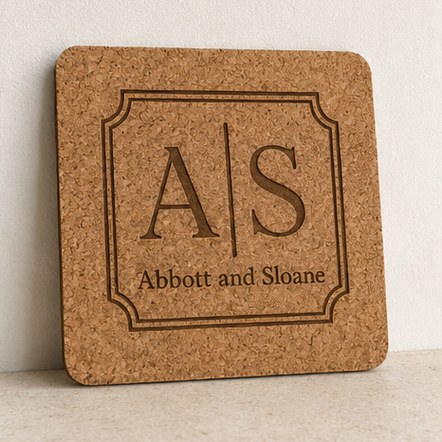
On custom cork coasters, plan your design to sit inside a safe area that stays clear of the outer edge. Cork is cut after or around decoration, and a design pushed right to the rim risks being clipped, sitting off-center, or meeting the edge where the material is least even. A comfortable margin all the way around keeps the logo looking deliberate rather than cramped.
Round and square coasters handle layouts differently. A round coaster rewards a centered mark, a circular badge or a short wordmark stacked over a tagline. A square coaster gives you corners to work with, so horizontal logos and layouts with a small line of text along the bottom fit more naturally. If your logo is very wide and short, a square shape usually shows it larger than a round one can.
Full-bleed artwork, where color runs right off the edge, is possible on full-color printed cork but needs extra background extended past the cut line so no bare strip appears. The mockup from Custom Cork Coasters shows your art placed on the actual coaster shape, so you can judge size and margins before anything is produced. Our guide on sizes, shapes, thickness and edges covers the blank itself.
Which design details get lost on cork, and how do I fix them?
Cork is a natural material with visible grain, so the details most likely to get lost on custom cork coasters are the smallest ones: thin hairlines, tiny type, faint tints and tight gaps between letters. The fix is to simplify before production, not to hope the material behaves like coated paper.
The grain pattern is part of the charm, but it adds texture under every mark. Ultra-thin strokes can break into dotted lines, small serif type can fill in, and a legal line or website address set in a very light weight may become hard to read. Most brands have a simplified or icon version of their logo for small uses such as favicons and app icons; that version is often the best starting point for a coaster.
- Thicken hairlines so every stroke reads clearly at arm’s length.
- Enlarge or drop small text; keep only the words a guest actually needs.
- Open up tight spacing between letters and between the logo and the tagline.
- Remove soft effects such as shadows, bevels and glows, especially for engraving.
- Choose strong contrast for print, since pale tones sit on a tan background.
If you are not sure which version to use, send both the full logo and the simplified mark. The design team at Custom Cork Coasters can show them side by side in the mockup so you can choose with your own eyes.
How do I handle names, dates and personalization in the artwork?
Personalized custom cork coasters, such as wedding favors with the couple’s names and date or staff gifts with individual names, need a clean master layout plus a simple list of the text that changes. Design the shared elements once, mark which line is variable, and supply the names or dates in a spreadsheet or a plain list.
A list keeps spelling under your control. Copy names straight from your guest list or staff roster rather than retyping them, and check accents, capitalization and hyphens before you send. Decide up front how long names will be handled: whether a long name drops to a smaller size, wraps onto a second line, or uses a shortened form. Agreeing on that rule early prevents surprises in the proof.
For wedding cork coasters, the most common layout pairs a monogram or simple motif with names and the wedding date. For corporate orders, a single logo on every coaster with the personalized line beneath it keeps the set consistent. Custom Cork Coasters shows the variable line on the mockup so you can see how a short name and a long name both look before approving.
What happens at the proof stage for custom cork coasters?
At the proof stage for custom cork coasters, you receive a free digital mockup within 24 hours showing your artwork placed on the coaster shape, with the decoration method noted. You check it, request changes, and approve only when it is right. Revisions are unlimited and free, and nothing is produced or charged until you sign off.
Read the proof the way a guest will see the coaster. Check that the logo is the current version, the colors match your brand guide, every word is spelled correctly, and the design sits well within the edge. On personalized orders, scan the full name list rather than a sample. Ask a second person to check it too; fresh eyes catch the errors you have already read past.
- Is this the latest logo, not last year’s version?
- Are phone numbers, web addresses and handles current?
- Does the layout suit the shape you chose?
- Have you decided between engraving and full-color print?
Once you approve, production starts and standard turnaround is about 2 weeks, with faster options available through express shipping. Late artwork changes are the most common reason a date slips, so settle the proof as early as you can. Our how it works page walks through each step.
What artwork mistakes do first-time cork coaster buyers make?
The artwork mistakes first-time buyers of custom cork coasters make most often are sending a low-resolution logo, expecting a gradient to engrave, choosing pale colors that disappear on tan cork, and filling the face with too much text. Each one is easy to avoid when you know the material before you design.
Another common slip is designing on a white artboard and forgetting that cork is not white. A logo that looks balanced on a white screen can feel heavier or lighter on a warm natural background, which is why a mockup on the real material is so useful. Buyers also sometimes approve without checking the variable list on personalized runs, or send a logo with stray fonts that have not been converted to outlines.
Finally, avoid treating a coaster like a business card. A coaster is seen in passing, under a glass, at a bar or a reception table. One clear mark and, at most, a short line of text will do more for your brand than a crowded layout. For branded orders, see cork coasters with logo; for larger volumes, see bulk cork coasters. Orders start at a minimum of 12.
Frequently asked questions
Can you work from a logo that I only have as a JPG?
Custom cork coasters can usually be made from a JPG logo, as long as the file is large and sharp. Custom Cork Coasters reviews every upload and will say in the free mockup whether the image is clean enough or needs redrawing. Small, blurry or compressed JPGs often need cleanup before engraving or print, so send the biggest original version you can find.
Should fonts be converted to outlines before I send cork coaster artwork?
Cork coaster artwork should have fonts converted to outlines, or the font files included, whenever you send a vector file. Without outlines, the design software may substitute a different typeface and your wordmark can shift or change shape. Converting text to outlines locks every letter in place, so the mockup and finished coasters match exactly what your designer created.
How do I keep white parts of my logo when printing on cork?
White areas on printed cork coasters need a white ink layer, otherwise they show as bare natural cork. Tell the team which parts of the logo must stay white when you submit your file. On engraved cork, white areas simply remain unburned cork, so a reversed logo may need to be flipped to read correctly. The mockup shows how each version will look.
Can a photograph be reproduced on cork coasters?
Photographs can be reproduced on full-color printed cork coasters, though the natural tan of the cork softens bright whites and pale skies. High-contrast images with strong subjects print best. Photos do not translate well to engraving, which turns everything into a single tone. Custom Cork Coasters can show a photo layout in the free mockup so you can judge the result first.
Can each cork coaster in one order carry a different design?
Cork coasters in a single order can carry variations such as different names, dates or table numbers on a shared layout. Supply a master design plus a clear list of the changing text. Completely different artwork on each coaster is a separate conversation, so describe what you want in the quote form and Custom Cork Coasters will confirm what fits one run.
Do I need a designer to prepare artwork for cork coasters?
Most buyers of custom cork coasters do not need to hire a designer. If you have a logo file and know what text you want, the team can place it, adjust it for engraving or print, and show you a mockup. A designer helps when you want an original illustration or a fresh layout, but simple branded coasters rarely require one.
What should I write on the back of my cork coasters?
The back of most cork coasters is left plain, because the underside sits against the table and is rarely seen. Spend your design effort on the face that guests actually look at. If a reverse-side message matters to you, such as a short note on a gift set, mention it in your quote request so the team can confirm whether it suits your chosen coaster.
How do I match my exact brand color on printed cork coasters?
Matching a brand color on printed cork coasters starts with sending the Pantone reference or CMYK values from your brand guide. Cork's warm natural base shifts how ink appears, so very pale or delicate shades may read slightly differently than on white paper. Custom Cork Coasters flags color concerns at the mockup stage, before you approve anything for production.
Can I see my coaster artwork on both round and square shapes?
Cork coaster mockups can show the same artwork on round and square shapes so you can compare them before deciding. Ask for both in your quote request. Wide logos often fit square coasters better, while badges and stacked marks suit round ones. Seeing them side by side is free and usually makes the choice obvious within one round of review.
What if I spot an error after approving my cork coaster proof?
An error spotted after approving a cork coaster proof should be reported straight away, because production begins soon after approval. Contact Custom Cork Coasters as quickly as possible and the team will check whether the run can still be changed. The safest protection is a careful review of every proof line, including full name lists, before you give the final sign-off.
Does cork grain affect how a QR code scans on a coaster?
QR codes on cork coasters need extra care, because natural grain and tan color reduce contrast compared with white paper. Keep the code large, place it on a solid area, and use dark ink for printed versions. Engraved codes are harder to scan reliably. Test the code from the mockup on your own phone, and ask the team about the best placement.
Is there a limit on how much text fits on a custom cork coaster?
Custom cork coasters have room for a logo plus a short line or two of text before the face starts to feel crowded. The real limit is legibility: text has to stay large enough to read at a glance on a table. If your message runs long, the team at Custom Cork Coasters can suggest a trimmed version or a simpler layout in the mockup.
Get a free mockup for your cork coasters
Send your logo or idea and the quantity you have in mind. Custom Cork Coasters returns a free mockup within 24 hours, you approve the design before anything is produced, and standard turnaround is about two weeks with faster options available. Get a custom quote.